
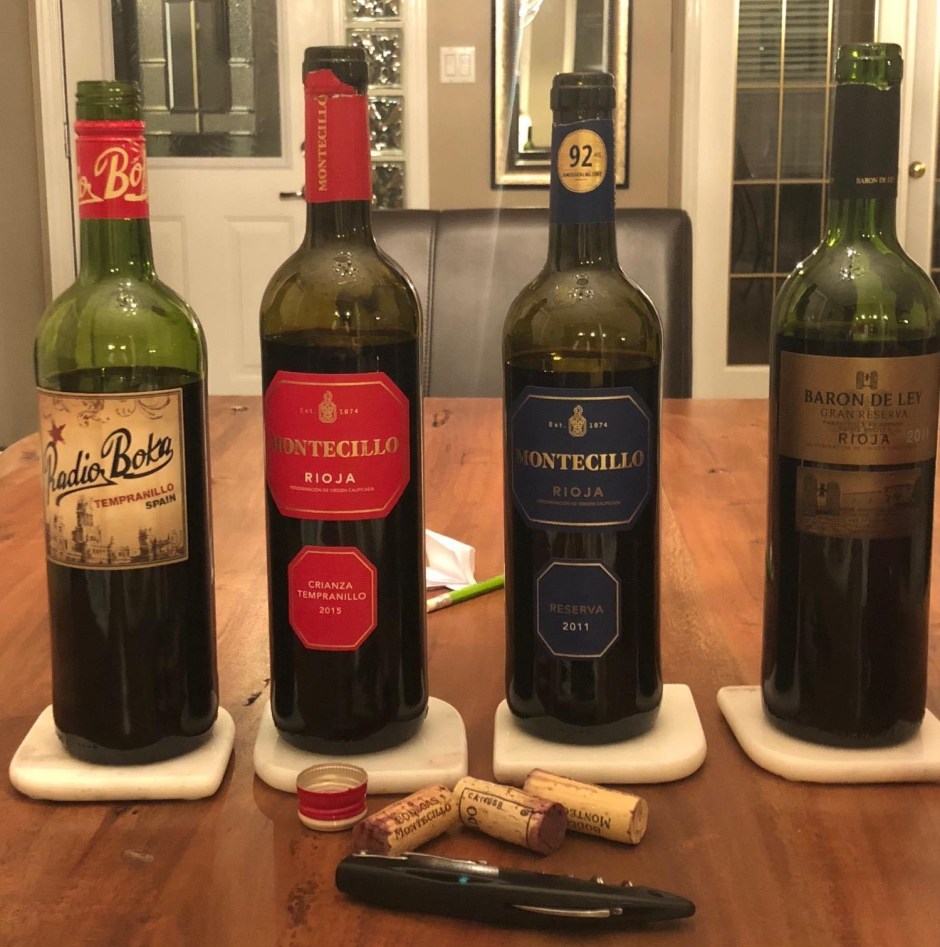
Looking for something fun to do this weekend? Stay home and have your own Spanish wine-tasting! We recently sampled a taste of Spain by age category – a great way to compare quality levels, aromas and flavours.
What are Spanish ageing requirements, anyway?
There are four age categories defined by Spanish law. In many cases the wine-maker will age their wines longer, so these categories basically define the minimum ageing requirements.
- Joven – these wines are for immediate drinking, with no specific ageing requirements. They are bottled in the year after the grapes are harvested and may or may not spend time in the barrel. Most labels won’t include the word “Joven” and will typically just show the name of the grape or region (i.e., Tempranillo, Rioja)
- Crianza – aged for a minimum of 24 months, with six of those spent in small oak barrels and the rest in the bottle.
- Reserva – aged for a minimum of 36 months, with at least 12 of those spent in small oak barrels and the rest in the bottle.
- Gran Reserva – aged for a minimum of 60 months, with at least 18 of those spent in small oak barrels and the rest in the bottle. These will be the most expensive, as they are only made in the very best vintages.
How to set up your Spanish wine-tasting:
- Purchase a bottle of each wine noted above (we tried Radio Boka, Montecillo Crianza, Montecillo Reserva & Baron De Ley Gran Reserva)
- Prep the table – you’ll need a corkscrew, white paper (8.5×11 sheets to use as place mats), pens & wine glasses (four for each person)
- Don’t forget water (for cleansing the palate between samples) & snacks (aka tapas such as flatbread & stuffed olives).
- Select a tasting format:
- Youngest to oldest– pour a glass of each wine in order from Joven to Gran Reserva and set these on the white paper in front of each person.
- Blind – Not as kinky as it sounds! A blind tasting is where you taste a wine without knowing which one you are sampling, then try to guess the correct wine. So you pour the four wines for your partner (and secretly write down which wine is which), and your partner does the same for you. Taste, guess and do the big reveal at the end. We typically always do blind tastings – it’s a great challenge.
- Sample time! Take notes as you try each wine. Here’s few pointers to guide you:
- Sight: Study the colour. Use the white paper as a backdrop to look at it. Is it clean? Is it bright? How would you describe the colour?
- Smell: Give the glass a swirl to release the aromas and then smell the wine. What does it remind you of? Can you pick up specific aromas of fruit, spice, flowers or oak?
- Taste: Finally, sip the wine. What do you taste? Try to identify flavours. How sweet or dry is it? How intense is it? Is it full or light body? Can you feel the tannins?
For the record – I crushed our blind tasting and got all four wines right! Knowing there was a quality difference based on the age really helped me hone in on the aromas and flavours. It also exposed how (in this case) age and price certainly make a difference.
Below are a few pics of our Spanish wine-night. And yes, Spain is most definitely on our bucket list of wine travel destinations. Cheers!




 thewineblossom.com